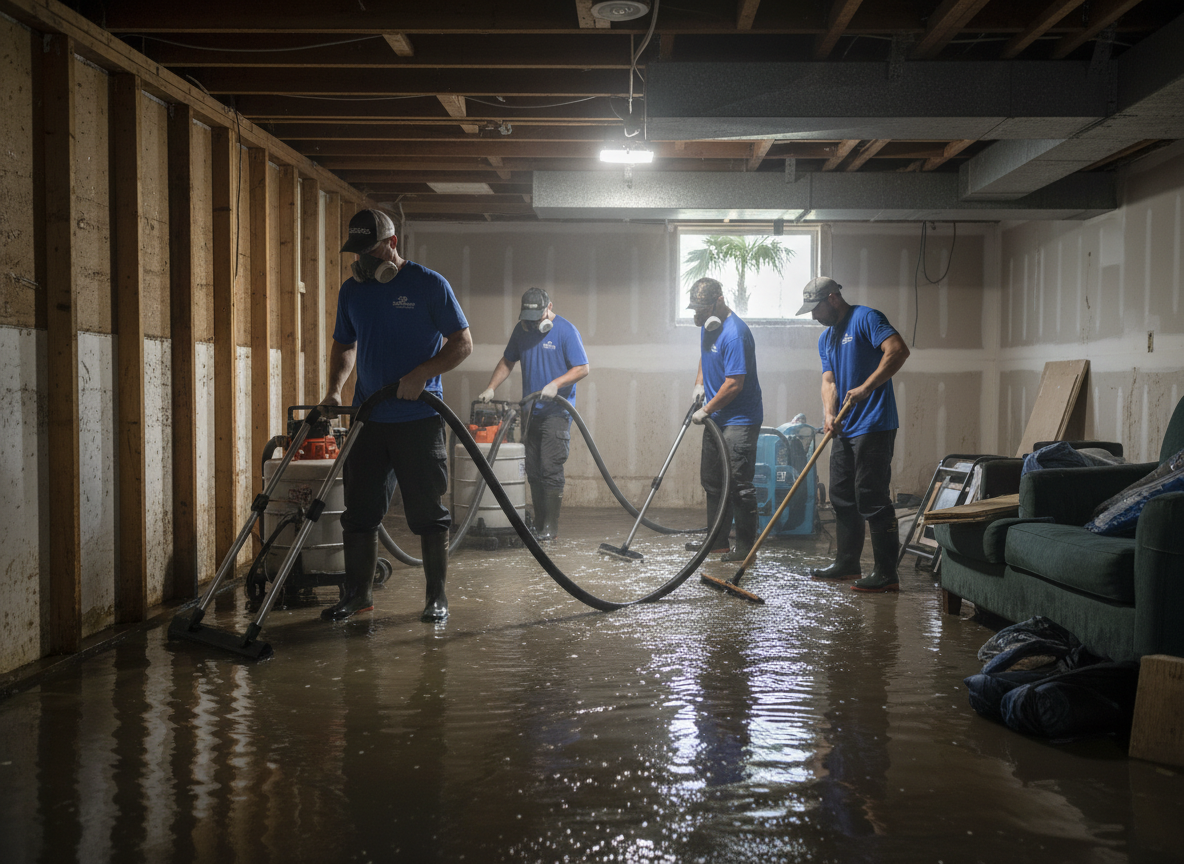
An inch of water on a Fort Myers garage floor looks like a simple job. It is usually not. By the time it is visible, the water has already moved under the water heater, into the bottom plate of the wall and up the paper facing of the drywall, and the garage slab is holding moisture that a towel will never reach. Water removal starts with getting the standing water out, then follows it into the materials that quietly kept it.
Why Fort Myers owners call us for water removal
Water removal is judged on what is left behind, not on how fast the floor looks dry. The visible puddle is the easy part. The work is in the materials that absorbed it.
We follow the water past the puddle. A meter and a thermal camera show how far water travelled under a floor, into a cabinet base or up a wall. That boundary decides what can be dried and what has to come out, and it is marked before extraction begins.
We remove what cannot be saved, and only that. Saturated carpet pad usually comes out. A solid cabinet that can be dried may stay. The distinction is made from readings and material, not from a standard demolition list, so you are not paying to remove material that could have been kept.
We dry against numbers. Air movers and dehumidifiers are positioned to move air where the readings say the water is. The job ends when the same marked points read dry against a reference of the same material, and the final numbers are written down.
We name the source. Standing water came from somewhere: a supply line, a water heater, a door track, a lanai drain or a storm. We identify it and say whether the repair is ours or belongs to a plumber, a roofer or the building.
We do not invent credentials. No licence number, certification, insurance certificate, founding year, project count or review is published here, because this business has not supplied any. The method is what we can show you.
Why standing water cannot be left overnight in this climate
A Fort Myers house is a humid building even when nothing is leaking. Air conditioning keeps the air cool, and cool air holds less moisture, so the system is constantly removing water from the rooms. When standing water is added, the system is suddenly asked to remove far more than it was designed for. The result is higher relative humidity in rooms that never got wet, and condensation on cool surfaces such as tile, cabinet fronts and window glass.
Water also moves. It wicks up drywall, travels along a slab, soaks into carpet pad and sits in the bottom plate of a wall. A room can look dry at the surface while the assembly behind it stays wet for a week. In this climate, a damp surface can support growth in about a day or two, especially where the air is still and the material is organic, such as paper facing, wood or textile.
Storm season adds a second problem. Between 1 June and 30 November, a water removal job often happens while more rain is falling and the ground is already saturated. Water that would drain away in a drier week has nowhere to go, and the humidity outside is high enough that opening the windows does not help. Hurricane Ian, which made landfall in Lee County in September 2022, is the reference point most local owners use for how quickly a storm can put water where it was never expected.
The practical cost of waiting is material. Carpet and pad that could have been dried are removed. A cabinet base that could have been saved swells and has to be replaced. A wall that could have been dried in place has to be opened. The earlier the water is extracted and the boundary is read, the smaller the final scope.
What you can check before you book water removal
Mold Remediation Fort Myers FL works from 8710 Alico Rd, Fort Myers, FL 33912, in Lee County. The phone number is (239) 499-1170 and it reaches the business at that address, which is also shown in the footer of every page here.
The services are exactly three: water damage restoration, which merges extraction, leak detection and storm damage; water removal, this page, for standing water and saturated material; and mold remediation, for containment, removal and moisture-source correction. Nothing outside that list is offered, and we will say so if your job needs a trade we do not cover.
The service area is Fort Myers plus eight Lee County communities: San Carlos Park, Three Oaks, Estero, Cypress Lake, Gateway, McGregor, Fort Myers Beach and Cape Coral. All are within about ten miles of the Alico Road address. We do not claim towns farther away to make the map look larger.
We do not publish certifications, a licence number, an insurance certificate, a founding year, staff biographies, project counts or customer reviews. None of those are facts this business has given us to state. If a credential matters for your building or your insurer, ask on the call and we will tell you what we do and do not hold.
A 1980s villa with a sunken lanai and a failed hose bib
A common south Fort Myers house is the 1980s villa: single storey, concrete block, stucco outside, a low-pitch roof and a screened lanai that sits a step down from the living room. The lanai usually has a drain, and the drain is usually the lowest point on the property. That is fine until the drain clogs with leaves or the hose bib on the lanai wall fails.
A failed hose bib can run unnoticed for hours, especially if the owner is at work or the house is closed for the season. The lanai fills, the water reaches the slider track and then crosses the threshold into the carpet. From there it spreads under the carpet pad into the bedroom and along the wall base. The visible water is in the lanai; the damage is inside the house.
What makes this different from a simple extraction is the step-down and the slider. Water sits against the track and the threshold, and the wall below the slider is often the wettest part of the assembly. The lanai slab is also lower than the interior floor, so water can remain under the lanai tile or paver base after the surface looks clear. If the lanai was enclosed later, the original exterior wall may still be behind the new finishes, with a cavity that holds water.
We start by reading the interior wall base and the carpet, not the lanai, because that is where the damage will show. The carpet and pad are pulled back where they are wet, the slider track and threshold are read, and the lanai slab is checked at several points. If the water crossed into a bedroom, the cabinet base and the wall behind it are read as well. The drying plan then covers both sides of the slider, because drying only the interior leaves the source side wet and the problem returns at the next rain.
The repair side matters too. A hose bib is a plumbing repair, and the lanai drain may be a landscape or drainage issue. We identify both, correct what is inside our scope and name the rest. The written record shows the readings before and after, so the plumber and the owner are working from the same evidence.
Where standing water hides in a Fort Myers home
Four materials hold water long after the surface looks dry. Each one changes how a water removal job is scoped, and each one is read before removal is proposed.
Carpet, pad and the tack strip
The component is the carpet, the pad underneath it, the tack strip along the wall and the subfloor below. Carpet is designed to let air through, which is why it feels dry quickly on top while the pad underneath stays soaked. Pad is a sponge, and once it is saturated it usually cannot be dried in place. What you notice is a damp smell, a dark patch that does not fade or a carpet that feels cool underfoot days after the water. The first move is to pull back a corner and read the pad and the subfloor; if the pad is wet, it comes out, and the carpet is assessed separately.
Cabinet bases and toe kicks
The component is the cabinet box, the toe kick, the shelf and the particleboard or plywood base that sits on the floor. Particleboard wicks water upward and swells, and the damage is often hidden behind a closed door. What you notice is a soft toe kick, a cabinet door that no longer closes squarely, a musty smell at floor level or a dark line where the cabinet meets the floor. The first move is to open the cabinet, remove the shelf and read the base and the wall behind it. A cabinet that has taken clean water may be dried and kept; one that has swelled or taken contaminated water usually has to be replaced.
The wall base and the bottom plate
The component is the drywall, the baseboard, the bottom plate of the frame and the insulation in the cavity. Water climbs drywall by capillary action and sits against the bottom plate, which is often the last part of a wall to dry. What you notice is a swollen baseboard, paint lifting at the corner, a tide line a few inches above the floor or a smell that is strongest near the skirting. The first move is to remove the baseboard at the wet section and read the plate and the cavity. Drying a wall without opening the base is possible only when the readings show the water never reached the plate.
The air handler, ducts and the closet floor
The component is the air handler, the evaporator coil, the condensate pan, the drain line and the ductwork that carries cool air through the house. Water that reaches the closet floor can be pulled into the return air and spread humidity through rooms that never got wet. What you notice is a musty smell at the registers, condensation on the duct insulation or a damp patch on the closet floor under the unit. The first move is to switch the system off, empty the pan and check the drain before the unit runs again. Running the air handler while its closet is wet spreads moisture through the whole house.
How a water removal job runs, step by step
- Call and triage. Describe where the water is, how deep it got and whether it is still running. We tell you what to shut off and which rooms to keep clear.
- Read the extent. Meters and thermal imaging establish how far the water travelled beyond the visible puddle, including carpet pad, cabinet bases and wall cavities.
- Extract. Standing water is removed from floors and low points, then water held in carpet and pad is extracted or the saturated material is removed.
- Remove what cannot be dried. Saturated pad, swollen particleboard and contaminated porous material come out and are bagged for disposal.
- Dry and monitor. Air movers and dehumidifiers are positioned against the marked readings, and the points are checked again until the assembly reaches a dry standard.
- Verify and hand back. Final readings are compared with day one, the rooms are walked with you, and you receive a written record of what was removed, what was dried and what remains for another trade.
What's included in water removal
- Extraction of standing water from floors and low points
- A moisture survey of carpet, pad, cabinet bases and wall cavities
- Removal and bagged disposal of saturated or contaminated material
- Air movers and dehumidifiers positioned against marked readings
- Monitoring while equipment is running
- A final reading compared with a dry reference of the same material
- Photographs and a written record of what was removed
- A named hand-off where the source repair belongs to another trade