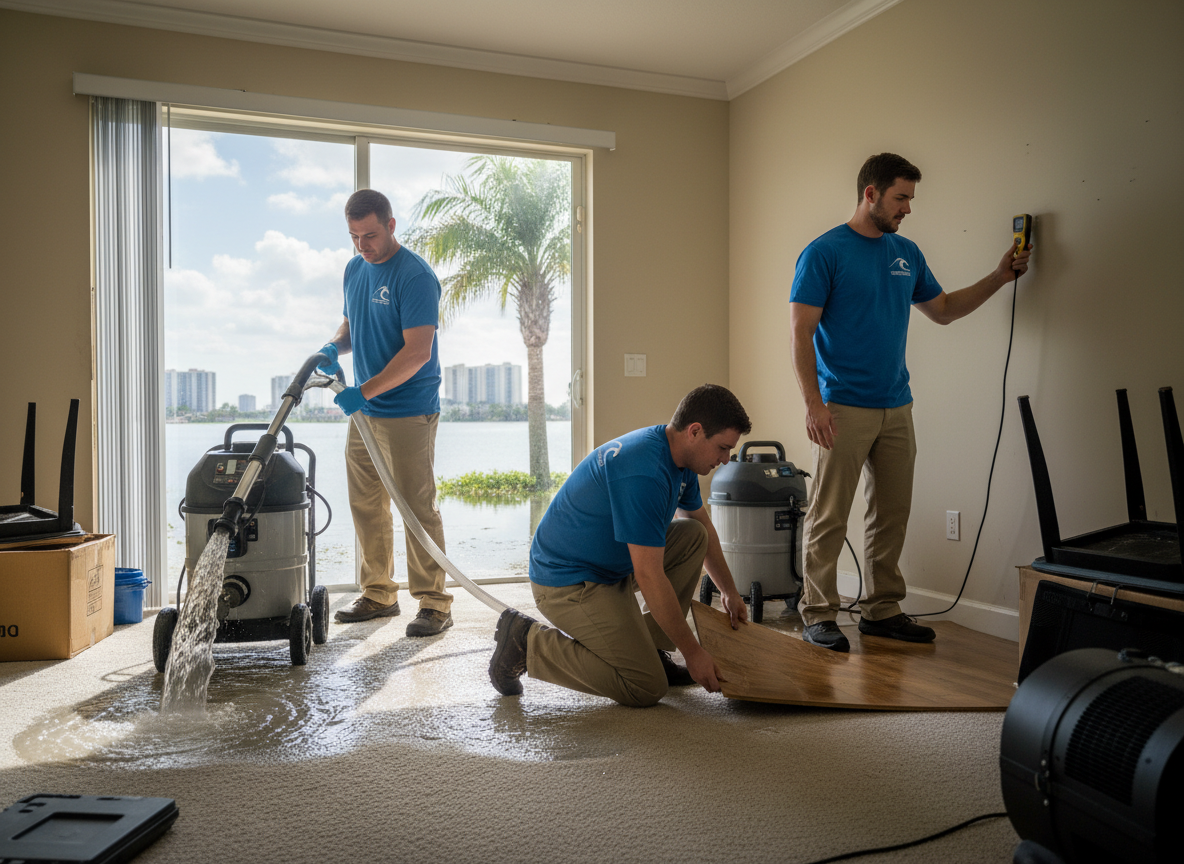
McGregor is a community defined by the river. The tidal Caloosahatchee runs along its northwest edge, more than 40 percent of the community is water, and the Cape Coral Bridge crosses from it. When the river is high and a summer storm sits over the county, water does not need a pipe to get into a house. It comes through a seawall, a dock line, a window track or the wall base, and it leaves salt and silt behind. That is the first thing we read on a McGregor call.
What makes water damage in McGregor different?
McGregor is an unincorporated Lee County community of 7,976 people (2020 census) on the tidal Caloosahatchee River, across from Cape Coral. It has a long-established housing stock, a high share of seasonal units and a waterfront geography that makes river flooding a real risk, not a remote one.
A community that is more than 40 percent water
McGregor covers about 4.1 square miles, of which roughly 1.7 square miles, or 41.86 percent, is water. The CDP is bordered to the northwest by the tidal Caloosahatchee River, with Cape Coral on the other side, and by Whiskey Creek, Cypress Lake and Iona on its other edges. That means the water level that matters is not just the rain falling on the roof; it is the river. During a named storm, surge is the coastal risk, and Hurricane Ian made landfall in Lee County in September 2022. In an ordinary summer system, it is the combination of high river, saturated ground and rain that cannot drain.
Old Florida houses and post-war ranch homes along the boulevard
McGregor's housing developed over a long period. Some Old Florida homes along McGregor Boulevard date to the 1930s and 1940s, much of the neighborhood was built between the 1950s and the turn of the century, and the corridor includes some of the oldest housing in the Fort Myers area. The boulevard is also the route of the royal palms planted in the 1920s, and the Edison and Ford winter estates sit nearby. For a water job, the age of the house decides the assembly: plaster and lath, concrete block, terrazzo, original plumbing and window systems that were not designed for the way the house is used today.
Tidal river, sandy ground and a high water table
The ground along the river is sandy and low, and the water table moves with the tide. A wall base that is only a foot above the river level can be wet from below even when no rain has fallen. Salt water leaves residue in the wall base, behind baseboards and in cabinet floors, and that residue holds moisture after the visible water is gone. The practical consequence is that a river flood is not the same as a clean supply-line leak: material that took salt water is usually treated as contaminated, and cleaning matters as much as drying.
Who serves McGregor
McGregor is unincorporated Lee County, so building permits and drainage questions go to Lee County rather than a city. The Cape Coral Bridge connects the community to Cape Coral, and McGregor Boulevard, State Road 867, is the main road through it. The corridor includes historic properties, and work on an older or historic house may involve more than a standard permit. For a water job, the first questions are the river level, the age of the assembly and whether the repair belongs to the county, the owner or a plumber.
What does a McGregor home need?
A McGregor home usually needs the river ruled out as the water source before the inside is opened, because a high tide and a saturated wall base can look exactly like a plumbing leak. The read comes first.
When water has entered from the river, a storm or a door track, water damage restoration covers extraction, leak detection and storm damage work. On a riverfront lot the entry point is often a seawall, a dock line, a window track or the wall base rather than the roof, and salt water changes what can be saved.
When water is standing in a garage, a lanai or a carpeted room, water removal is the direct job. Carpet pad, cabinet bases and the bottom plate hold water in these homes, and older cabinet bases swell quickly. Extraction and drying are judged on readings at those materials.
When a wall or a cabinet has stayed damp long enough to smell, mold remediation follows. Containment matters in an older house, because plaster and lath can hide growth in a way drywall does not. We contain the area, remove what cannot be saved and correct the moisture source.
We also cover Cypress Lake, Cape Coral, San Carlos Park, Fort Myers Beach and Three Oaks, all within about ten miles of McGregor.
Why use us in McGregor?
Because a riverfront house needs the water source read before the wall is opened, and older construction needs a gentler approach. We read the wall base, the window head, the seawall side and the cabinet floors, and we separate the water work from the plumbing, roofing, seawall or historic-repair work that belongs to another trade. We work from 8710 Alico Rd in south Fort Myers, a short drive from McGregor, and we put the readings and the scope in writing. We do not publish credentials or reviews this business has not supplied.
Why McGregor water damage gets worse quickly
A damp wall in McGregor is a growth environment for most of the year, and the river keeps the local humidity high. Air conditioning cools the interior, which leaves cool surfaces below the dew point whenever moisture rises, and a wall base that took river water stays damp long after the surface feels dry. Growth can begin in about a day or two.
The storm season adds a second problem. From June through November, the river is high, the ground is saturated and the next system arrives before the last one has drained. A window track that leaked once will leak again. A cabinet base that took salt water in July is still holding moisture in September. Waiting usually means removing plaster, cabinets and baseboards that could have been dried if the water had been read sooner, and in an older house that removal is more expensive to put back.
How a McGregor job runs, step by step
- Call and river level. Tell us where the water appeared, whether the river was high and what has already been repaired.
- Read the assembly. We mark reading points at the wall base, window head, cabinet floors and door tracks, and scan concealed areas with thermal imaging.
- Contain and extract. The work area is contained where growth is likely, standing water is extracted and salt-affected material is assessed.
- Dry against readings. Air movers and dehumidifiers run at the marked points until the assembly reaches a dry standard.
- Verify and hand back. Final readings are compared with day one, and the record names any plumbing, roofing, seawall or historic repair that belongs elsewhere.
What's included in a McGregor job
- A moisture survey of wall bases, window heads, cabinet floors and door tracks
- Thermal imaging where the entry point is concealed
- Extraction of standing water and removal of salt-affected material
- Containment and HEPA filtration where growth is disturbed
- Drying equipment positioned against marked readings
- A written record of readings before and after
- A named hand-off for plumbing, roofing, seawall or historic repair
What a riverfront McGregor wall tells us
On a McGregor riverfront, the wall base is the first thing we read, because it answers the question the owner cannot: did the water come from the river or from a pipe? The two look identical from inside, and they are handled differently.
River water leaves a line. It carries silt and salt, it rises with the tide, and it usually affects the lowest point of the assembly first: the bottom plate, the cabinet toe kick, the lanai track, the base of a stucco wall. A supply-line leak does the opposite. It runs from a source at pressure, so the damage is concentrated where the pipe failed and spreads upward or along a cabinet run. A stain that follows the tide line is a river mark; a stain with a wet ceiling above it is a pipe mark.
The age of the house decides what that mark means. Some McGregor homes date to the 1930s and 1940s, with plaster and lath, terrazzo and original plumbing, while much of the community was built between the 1950s and the end of the century. Plaster holds water differently from drywall: it dries more slowly, it can hide growth behind the finish, and it cannot be replaced with a modern patch without showing. In a historic or older house, the repair is a separate trade from the drying, and the scope should say so.
Salt is the last part. River water leaves residue in the wall base and behind baseboards, and that residue keeps pulling moisture after the visible water is gone. Material that took salt water is usually assessed as contaminated, which changes what can stay and what has to go.
What should you do next?
Call (239) 499-1170 and tell us where the water is, how high the river was and whether the house is on the river side of the boulevard. If the wall base is wet and the tide is still rising, keep the room clear. We cover McGregor from 8710 Alico Rd in south Fort Myers.
Around McGregor
We regularly work near:
- 📍McGregor Boulevard
- 📍Cape Coral Bridge
- 📍Edison and Ford Winter Estates nearby
Mold Remediation in McGregor — Local Notes
- •Unincorporated Lee County, so permits go to the county.
- •Bordered by the tidal Caloosahatchee River; the Cape Coral Bridge crosses from McGregor.
- •About 41.86 percent of the community's area is water.
- •Housing includes 1930s and 1940s homes and post-war construction.