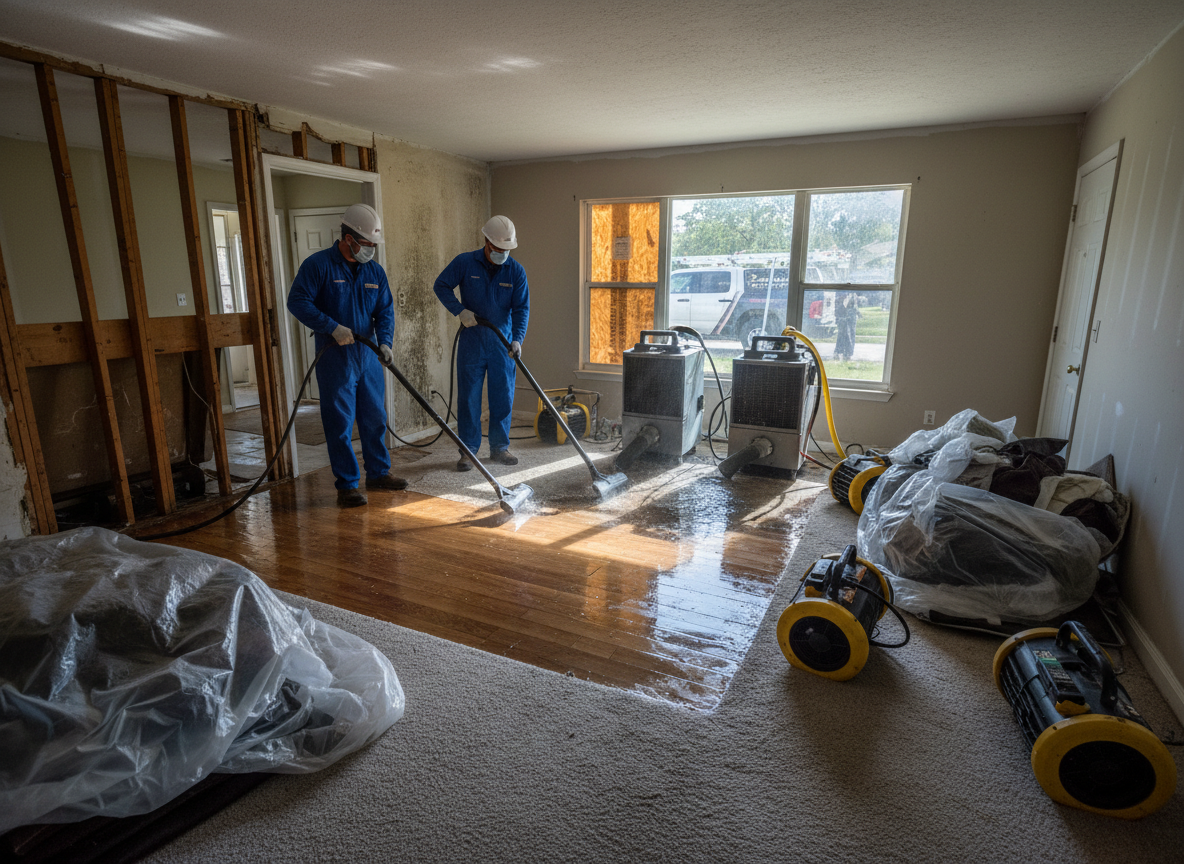
Storm water can get into a Fort Myers house through a window track and leave the floor looking dry by morning. The water has not gone. It has moved into the wall base, the carpet pad and the cabinet toe kick, where it sits while the air conditioning keeps the room cool. By the time a tide line appears, the material behind it has been wet for days. Water damage restoration starts with finding that hidden water and stopping what is still feeding it, not with a fan pointed at the visible patch.
Why Fort Myers owners call us before the ceiling comes down
Water work fails for predictable reasons: the source is never found, the wet boundary is guessed, or the job is called finished because a surface feels dry. Those are the points we build the job around.
The source comes before the equipment. A supply line, a condensate drain, a door track or a roof opening all leave different evidence. We identify which one is responsible before an air mover is set, because drying a room without correcting the source only moves the problem to the next rain.
The wet boundary is measured, not guessed. Moisture meters and thermal imaging tell us how far the water travelled beyond the visible stain. Reading points are marked by room and location and photographed, so the same spot can be checked again at the end of the job.
The scope is written before work starts. It separates emergency work from permanent repair and names what is being removed, what is being dried and what sits outside our trade. You can see where our work starts and stops before you commit to it.
One service, three phases. Extraction, leak detection and storm damage are not vague promises. They are the three phases of this service, each with its own equipment and its own end point, and each is scoped in writing.
The hand-off is named. A failed supply line needs a plumber, an opened roof needs a roofer and a rebuild needs a general contractor. We identify the component, dry what can be dried and say plainly which trade owns the rest.
Why a Fort Myers water problem gets worse while you wait
South Florida's indoor air is a growth environment for most of the year. Air conditioning runs almost continuously, which keeps interiors cool but also keeps relative humidity high whenever the system cycles off. Any surface that is cool and damp stays that way. Add a wet wall cavity, a leaking ceiling pan or a bathroom with no working exhaust and the conditions are already met.
Growth does not need a flood. It needs moisture, organic material and time, and in this climate the time is short. A damp surface can support growth in about a day or two. The calls we take are usually not dramatic: a ceiling stain from a storm three weeks ago, a closet behind a shower, the base of a wall below a sliding door, the paper facing of drywall in an air-handler closet. Each was a small water problem that nobody dried.
Hurricane season runs from 1 June to 30 November. When a storm pushes water into a house, the same week usually brings more rain, higher humidity and saturated ground, so materials that would dry slowly elsewhere do not dry at all. Hurricane Ian made landfall in Lee County in September 2022 with a storm surge reported at 10 to 15 feet along parts of the coast. The county is still carrying the rebuild from that storm, and rebuilt houses have their own drying problems.
The cost of waiting is not only the remediation. Material that could have been dried and kept has to be removed. Cabinets, baseboards and door casings that could have been saved are replaced. A contained job in one room can become a containment in three rooms with contents packed out. The earlier the moisture is read, the smaller the scope.
What you can check before you book water damage restoration
Mold Remediation Fort Myers FL operates from 8710 Alico Rd, Fort Myers, FL 33912, in Lee County. The number is (239) 499-1170, and it reaches the same business address shown in the footer of every page here.
The services are exactly three. Water damage restoration is this page, and it merges water extraction, water leak detection and repair, and storm damage restoration as named phases. Water removal covers standing water and saturated material on its own. Mold remediation covers containment, removal of affected material and correction of the moisture source. If a job needs something outside that list, we will tell you rather than stretch the description.
The areas are Fort Myers and eight communities in Lee County: San Carlos Park, Three Oaks, Estero, Cypress Lake, Gateway, McGregor, Fort Myers Beach and Cape Coral. Every one is within about ten miles of the Alico Road address. Fort Myers Beach is a barrier-island town on Estero Island and Cape Coral is a canal city across the Caloosahatchee, so the water entry points differ from the mainland.
We do not publish a licence number, a certification, an insurance certificate, a founding year, staff biographies, project counts or customer reviews, because none of those are facts this business has given us to state. We also do not present an air sample as proof of our own work. If you want independent clearance testing, that is a separate specialist service, and we will tell you honestly on the call what we can and cannot do about it.
A post-Ian rebuild where the new floor hides an old slab
Hurricane Ian made landfall in Lee County in September 2022, and the rebuild that followed is now part of the local housing stock. In south Fort Myers it is common to walk into a house that has a new luxury vinyl floor, new drywall, new cabinets and a new lanai screen, all installed after the storm. The house looks finished. The slab underneath it may never have been read.
A slab-on-grade house sits on sandy soil with a high water table, and older slabs often have no continuous vapour barrier under them. Water that enters at a door track, an irrigation line or a wall base can move laterally under a new floor and stay there, because the flooring is designed to keep surface water out. The first sign is usually a musty smell in one room, a swollen cabinet toe kick or a baseboard that has started to lift. The floor itself can feel perfectly solid.
The call we take often starts with the owner saying the house was rebuilt after Ian and should be dry. It should be, but a rebuild replaces finishes; it does not necessarily correct drainage, a door track that still holds water or a slab edge that still wicks. Our first step is to read the slab at several points, compare the wall base with an unaffected wall and check the exterior at the door and the irrigation stub. If the readings show the slab is wet under the new floor, the honest answer is that a section of floor has to come up. Drying a slab through a sealed floor does not work, and pretending otherwise costs the owner another season of smell.
What makes this different from a generic water job is the sequence. The new finishes are valuable and the owner does not want a demolition. We open the smallest area that lets us read the assembly, dry the slab and the wall base, correct the entry point where it is ours, and hand the flooring replacement to the trade that installed it. The written record names the readings before and after, so the flooring contractor is not working from a description.
This is also why we ask about the storm history on the first call. A house that was flooded, gutted and rebuilt is not the same building as one that has never been wet. The rebuild may have solved the obvious damage and left the drainage, the door track or the slab edge exactly as it was.
Where the water usually comes from
Four components account for most of the water damage we are called to in Fort Myers. Each is a failure point rather than a cleaning problem, and each needs the water corrected before anything is dried or removed.
A supply line behind a cabinet
The component is the braided or plastic line that feeds a sink, a dishwasher, an ice maker or a washing machine, usually behind a cabinet or inside a wall. These lines fail at the fitting, at the crimp or where they rub against a cabinet edge, and they can run for hours before anyone notices. What you notice is water on the kitchen floor, a swollen cabinet base, or a stain on the ceiling below if the line is upstairs. The first move is to close the fixture shutoff, then the main if the shutoff will not hold, and to keep the cabinet open so the area can be read. A supply line is a plumber's repair; the drying and the cabinet assessment are ours.
A water heater at the end of its life
The component is the tank, the pressure relief valve, the supply connections and the pan underneath. In a Fort Myers garage or closet, a tank can rust from the inside out and give no warning beyond a damp patch or a change in the sound of the burner. What you notice is water spreading across the garage floor, a rust line at the base of the tank or a musty smell in the closet. The first move is to shut off the power or gas and the cold-water supply, then read the wall base and the adjacent room. A tank that has leaked into a wall or under a floor covering is a drying job as well as a plumbing replacement.
A slab leak under a tile floor
The component is the copper or plastic pipe that runs through or under the slab, and the slab itself. A slab leak can be a pinhole in a hot-water line, a failed joint or a pipe that has been attacked by soil chemistry, and the water often surfaces far from the leak. What you notice is a warm spot on the floor, a water bill that has climbed, a baseboard that stays damp or a smell that is strongest in one room. The first move is to stop using the fixture and call a leak-detection specialist or a plumber; we read the slab and the wall base so the repair is not followed by a second, hidden moisture problem.
An air-handler condensate line that clogs
The component is the air handler, the evaporator coil, the primary condensate drain and the secondary pan with its float switch. In a Fort Myers home the system runs for most of the year, so it produces condensate every day and the coil stays wet. When the drain clogs with algae, water backs up into the pan and then onto the platform, the closet floor and the ceiling below. What you notice is a musty smell at the supply registers, a dark line along the closet baseboard or a rust ring on the platform. The first move is to switch the system off, empty the pan and check the float switch before the unit runs again.
The three phases of water damage restoration
This service merges three phases that are usually booked together but scoped separately. On a real job they run in sequence, and each one has its own process and its own list of what is included. Naming them separately is how you can see what you are paying for.
Water extraction
Extraction is the first phase and the one that limits how much material has to be removed. Standing water comes out of the floor, the carpet and the low points, then the materials that hold it are assessed. Carpet pad that is saturated usually comes out; carpet that took clean water and can be dried quickly may stay. The phase ends when the visible water is gone and the wet boundary has been read, not when the floor looks clear.
How extraction runs
- Confirm the water is still off and the room is safe to enter.
- Photograph the affected area and mark reading points.
- Extract standing water and the water held in carpet and pad.
- Read the wall base and cabinets to establish how far the water travelled.
- Remove saturated material that cannot be dried in place.
What's included in extraction
- Standing-water extraction from floors and low points
- Assessment of carpet, pad, cabinet bases and wall cavities
- Removal and bagged disposal of saturated material
- Marked and photographed reading points
- A written note of what was removed and why
- A hand-off to the drying phase with the readings that define it
Water leak detection and repair
Detection is the phase that decides whether the job will hold. A leak can enter at a roof, a window, a door track, a supply line, a drain or a slab, and the visible stain is often not where the water is entering. We trace the path with a meter and a thermal camera, confirm the entry point and separate the repair we can make from the repair that belongs to a plumber, a roofer or the building. Repair here means the correction inside our scope, not a rebuild of another trade's work.
How leak detection runs
- Interview the owner about when the water appears and what changed.
- Read the visible area and the assembly behind it with a meter.
- Scan concealed walls, ceilings and slab edges with thermal imaging.
- Trace the moisture back to the entry point and confirm it.
- Correct what is in scope and write down the hand-off for the rest.
What's included in leak detection and repair
- A moisture survey of the affected rooms and the assemblies around them
- Thermal imaging of concealed walls, ceilings and slab edges
- Confirmation of the entry point, not just the stain
- Correction of the source where it is inside our scope
- A written hand-off naming the trade that owns the rest
- Photographs of the path and the readings that support it
Storm damage restoration
Storm damage is the phase that deals with the envelope after wind-driven rain. A named storm does not have to open a roof to put water in a house; it can drive rain through a window track, a lanai tie-in, a soffit or a vent, and the water lands inside a wall that looks intact. We read the envelope, dry the assemblies that took water and identify the opening that has to be closed before the next storm. This is restoration of the water damage, not a roof replacement or a structural rebuild.
How storm damage work runs
- Ask which side of the house took the wind and where the water appeared first.
- Inspect the roof edge, window and door tracks, lanai and soffits from inside.
- Read the wall and ceiling assemblies that took water.
- Extract, remove and dry what the storm wet.
- Document the opening and hand the envelope repair to the right trade.
What's included in storm damage restoration
- Interior inspection after wind-driven rain
- Moisture readings at roof edges, window tracks, lanais and soffits
- Extraction and removal of storm-wet material
- Cavity drying where water entered a wall
- Photographs and a written record of the entry point
- A named hand-off for roof, window or structural repair
How a water damage job runs, step by step
Across the three phases, the sequence on a Fort Myers job is consistent. It starts with a call in which we ask what is wet, where it came from and whether water is still running. That conversation decides what to shut off, which rooms to keep clear and whether the visit is urgent. On site we read the affected rooms, mark the wet boundary and contain the work area before anything is disturbed. Standing water comes out, saturated material is removed, and air movers, dehumidifiers and cavity drying run against the readings we recorded. At hand-back we compare the final numbers with day one, walk the rooms with you and leave a written record of what was found, removed and read. If the source was a plumbing failure, a roof or a window, the record names the trade that owns that repair.