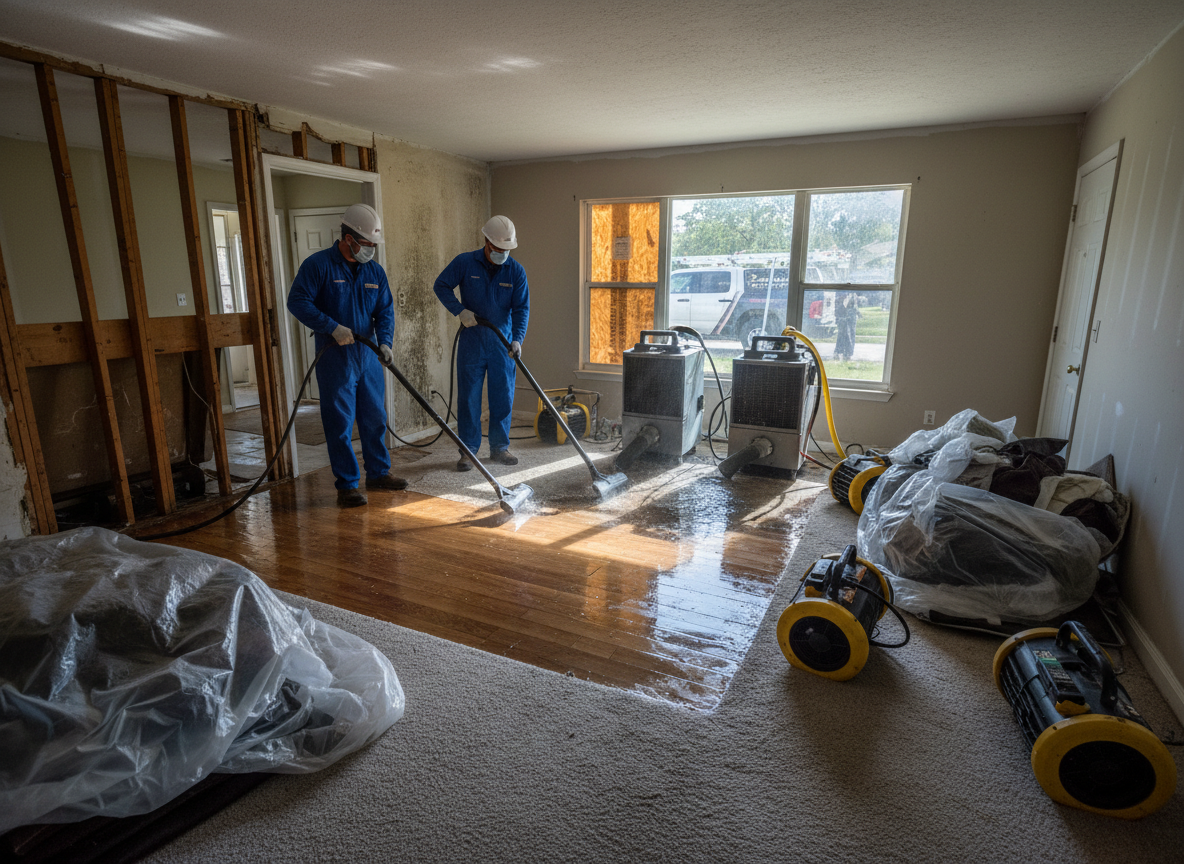
Gateway is a master-planned community built around golf courses and lakes, and water here often comes from the landscaping rather than the sky. An irrigation line runs against the same wall every morning, a lake rises after a storm, and the ground stays saturated in a way that a house on a drier lot never sees. Because the homes are newer and tightly built, the first sign is usually a smell at a return vent or a baseboard that has started to lift, not a puddle in the middle of the room. This page explains what we look for in Gateway and how a water or mold job here is scoped.
What makes water damage in Gateway different?
Gateway is a census-designated place in unincorporated Lee County with 10,376 residents (2020 census), built north of Southwest Florida International Airport. It is a 3,000-acre master-planned community, and its lakes, golf courses and irrigation systems are part of the water story.
The airport, I-75 and a flat, lake-dotted plain
Gateway sits north of Southwest Florida International Airport, east of the main Fort Myers urban area, on flat ground with a large number of constructed lakes. The community is close to I-75 and the Daniels Parkway corridor, which puts it in the path of the same summer storms that cross the county. Because the ground is flat and the lakes are the drainage, a heavy storm raises the water level and the surrounding soil stays saturated. That is when water finds a lanai, a garage slab or a wall base.
A 3,000-acre plan that broke ground in 1984
Gateway is a master-planned community of about 3,000 acres, with construction beginning in 1984 and the golf course opening for play in 1989. Development has continued since, so the housing stock includes 1980s homes, 1990s and 2000s neighborhoods and newer sections. The community includes gated neighborhoods, single-family homes, villas and condominiums. That range matters: an 1980s house has different plumbing and window systems from a 2010s house, and a villa shares walls in a way a detached house does not.
Stormwater lakes, irrigation and sandy ground
The lakes in Gateway are not only scenery; they are part of the stormwater system, and the irrigation system draws from them or from reclaimed water depending on the neighborhood. When the lakes are high, the soil around them is saturated, and irrigation that runs on a schedule can keep a wall base damp even in a dry week. The ground is sandy, so water moves laterally rather than straight down, and a slab edge can stay wet long after the surface looks dry. We ask about the irrigation schedule and the lake level before we read the wall.
Who serves Gateway
Gateway is unincorporated Lee County, so building permits and drainage questions go to Lee County. Many neighborhoods are gated and association-managed, which affects access, work hours and the route equipment takes. The community is next to Southwest Florida International Airport, and some of the newer sections are still being built, so construction traffic and drainage changes are part of the local picture. For a water job, the first questions are access and which association or owner controls the wall that is wet.
What does a Gateway home need?
A Gateway home usually needs the outside water source ruled out before the inside is opened, because irrigation and lake levels are often the cause. The read comes first.
When water has entered through a lanai, a door track or a window, water damage restoration covers extraction, leak detection and storm damage work. On a golf-course or lake lot, the entry point is often the lanai tie-in, the irrigation stub or a door track rather than the roof, and the water can travel inside a wall before it shows.
When water is standing in a garage, a lanai or a carpeted room, water removal is the direct job. Carpet pad, cabinet bases and the bottom plate hold water in these homes, and newer cabinetry can hide a swollen base behind a closed door. Extraction and drying are judged on readings at those materials.
When a wall or a cabinet has stayed damp long enough to smell, mold remediation follows. Containment matters in a tight, air-conditioned house, because disturbing growth without it can move spores through the rooms. We contain the area, filter the air and remove only what cannot be saved.
We also cover Three Oaks, San Carlos Park and Cypress Lake, all within about ten miles of Gateway.
Why use us in Gateway?
Because the water in Gateway often starts in the landscape, and ruling out irrigation and lake levels is the part that makes the job hold. We read the lanai, the door track, the irrigation stub and the wall base before proposing removal, and we separate the water work from the irrigation, plumbing or association repair that belongs to another trade. We work from 8710 Alico Rd in south Fort Myers, a short drive from Gateway, and we put the readings and the scope in writing. We do not publish credentials or reviews this business has not supplied.
Why Gateway water damage gets worse quickly
A damp wall in Gateway is a growth environment for most of the year, and the community's lakes and irrigation keep the local humidity high. Air conditioning cools the interior, which leaves cool surfaces below the dew point whenever moisture rises, and a wall base that took water stays damp long after the surface feels dry. Growth can begin in about a day or two.
The storm season adds pressure from outside. From June through November, the lakes are high, the ground is saturated and the next system arrives before the last one has drained. An irrigation line that runs against the house every morning can keep a wall base damp even when it has not rained. Waiting usually means removing drywall and cabinet bases that could have been dried if the source had been found sooner, and in a gated community it also means coordinating access twice.
How a Gateway job runs, step by step
- Call and access. Tell us where the water appeared, whether the house is gated and who manages access.
- Read the assembly. We mark reading points at the lanai, door track, wall base and irrigation stub, and scan concealed areas with thermal imaging.
- Contain and extract. The work area is contained where growth is likely, standing water is extracted and saturated material is assessed.
- Dry against readings. Air movers and dehumidifiers run at the marked points until the assembly reaches a dry standard.
- Verify and hand back. Final readings are compared with day one, and the record names any irrigation, plumbing or association repair that belongs elsewhere.
What's included in a Gateway job
- A moisture survey of lanais, door tracks, wall bases and irrigation stubs
- Thermal imaging where the entry point is concealed
- Extraction of standing water and removal of saturated material
- Containment and HEPA filtration where growth is disturbed
- Drying equipment positioned against marked readings
- A written record of readings before and after
- A named hand-off for irrigation, plumbing or association work
What gated access and lake levels change in Gateway
Gateway is gated for much of its length, and its lakes are the storm system as well as the view. A water job here is decided by two things that have nothing to do with the wall: who lets the equipment in, and how high the lake is when the rain stops.
Access comes first. Many neighborhoods are association-managed, with vendor rules, gate codes and set work hours, and drying equipment has to stay inside for days rather than hours. A gate pass that expires after the first visit will stop a job in the middle, so we ask for the property manager's contact and a pass that covers the whole drying period. Equipment routes matter too: a loaded truck and a containment frame may need the service entrance rather than the visitor lane.
Lake levels come second. The lakes hold stormwater, and when they are high the soil around them is saturated, so water can sit against a slab edge or a lanai tie-in long after the rain has passed. An irrigation system that draws from the lake keeps the same wall wet on a schedule, which is why a Gateway wall can read damp in a week with no rain at all. We check the lake side of the house and the irrigation heads before we open the interior.
Inside, the homes are newer and tighter than in the older parts of the county. A tight house holds moisture in the air, and a small leak behind a cabinet or above a ceiling can feed growth without leaving a visible stain. That is why the readings, not the appearance, decide the scope.
The airport corridor adds one more variable. Southwest Florida International Airport sits directly south, and the neighborhoods closest to it carry more traffic, more construction and more rental turnover than the interior of the community. A rental that turns over between seasons may have a water heater or an air handler that was replaced without a pan, and a tenant may report a smell long after the leak started. On those properties we ask who maintains the equipment and when it was last serviced, because the answer often explains the moisture.
What should you do next?
Call (239) 499-1170 and tell us where the water is, whether the home is gated and which side of the house faces the lake. Have the gate code or the property manager's contact ready so equipment is not turned away. We cover Gateway from 8710 Alico Rd in south Fort Myers.
Around Gateway
We regularly work near:
- 📍Southwest Florida International Airport
- 📍Gateway Golf & Country Club
- 📍Daniels Parkway
Mold Remediation in Gateway — Local Notes
- •Unincorporated Lee County, so permits go to the county.
- •A 3,000-acre master-planned community; construction began in 1984.
- •The community sits north of Southwest Florida International Airport.
- •Many neighborhoods are gated and association-managed.