In San Carlos Park, water often arrives from the ground up. A summer storm stalls over south Lee County, Mullock Creek and the roadside swales take the overflow, and the flat lots between U.S. 41 and Three Oaks stop draining. Water finds the lowest point in a wall base, a garage slab or a cabinet toe kick and stays there. The rain stops, the street clears and the damp stays inside the assembly. That is the problem this page is about: finding where the water went after the street looked dry.
What makes water damage in San Carlos Park different?
San Carlos Park is an unincorporated Lee County community of 18,563 people (2020 census) on flat ground that drains west through Mullock Creek to Estero Bay. It is not a coastal town and it is not a city with its own drainage department. The water problems here are rain-driven, ground-driven and, on some streets, well-driven.
Storm rain, Mullock Creek and the flat ground
San Carlos Park takes water from rain rather than tide. The CDP is about five square miles, and only about five percent of it is open water, so there is little storage when a summer storm sits over the area. Mullock Creek carries the drainage west toward Estero Bay, and when the creek and the swales are full, water backs up into low lots and finds the wall base. Hurricane season runs from 1 June to 30 November, and the storms that cause problems here are often ordinary afternoon systems rather than named hurricanes. The first move is to read the wall base and the garage slab, not the street.
A 1950s plat built out mostly in the 1990s
The community traces its beginnings to 1953 and the Freeman brothers, and its fire protection and rescue district was formed in 1976. Much of the housing was built out in the 1990s, alongside older ranch-style homes and new traditional houses added after 2000. That mix matters because a 1990s block-and-stucco house and a 2020s house hold water differently. The older homes often have original plumbing, window tracks and irrigation stubs; the newer ones have tighter envelopes that can hide a leak in a wall cavity for longer. We ask the age of the house before we set equipment.
Sandy soil, a high water table and a mix of city water and wells
The ground here is sandy and the water table is high, so a soaked lot does not dry from below. Some streets are served by city water and others still rely on private wells, which changes where a water problem can start. A well supply line, a pressure tank or an irrigation line can fail underground and send water toward a slab without ever showing at the surface. When the source is a well system, the repair belongs to a well contractor; our work is the water that reached the house and the material that stayed wet.
Who serves San Carlos Park
San Carlos Park is unincorporated, so land use, drainage and building permits sit with Lee County rather than a city hall. Water service is split between Lee County Utilities and private wells depending on the street. Fire protection and rescue come from the San Carlos Park Fire Protection and Rescue Service District, formed in 1976. For a water job, that means the permit conversation is a county conversation, and the water-source conversation may involve a well contractor as well as a plumber.
What does a San Carlos Park home need?
The short answer is a moisture read that starts at the wall base and the slab, because that is where rain-driven water ends up in this community. A house here usually needs extraction or drying before it needs anything cosmetic.
When storm rain has crossed a door track or a lanai, the work starts with water damage restoration. That service covers the three phases this community actually uses: extraction of the water that got in, leak detection to find the entry point at the track, the roof edge or the wall, and storm damage work on the envelope that let it through. On a 1990s house the entry point is often a sliding-door track or an irrigation stub rather than a roof.
When the water is standing in a garage, a lanai or a carpeted room, water removal is the shorter job. Carpet pad, cabinet bases and the bottom plate are the materials that hold water here, and the sandy ground means the slab stays cool and damp longer than the air does. Extraction and drying are judged on readings at those materials, not on how the floor feels.
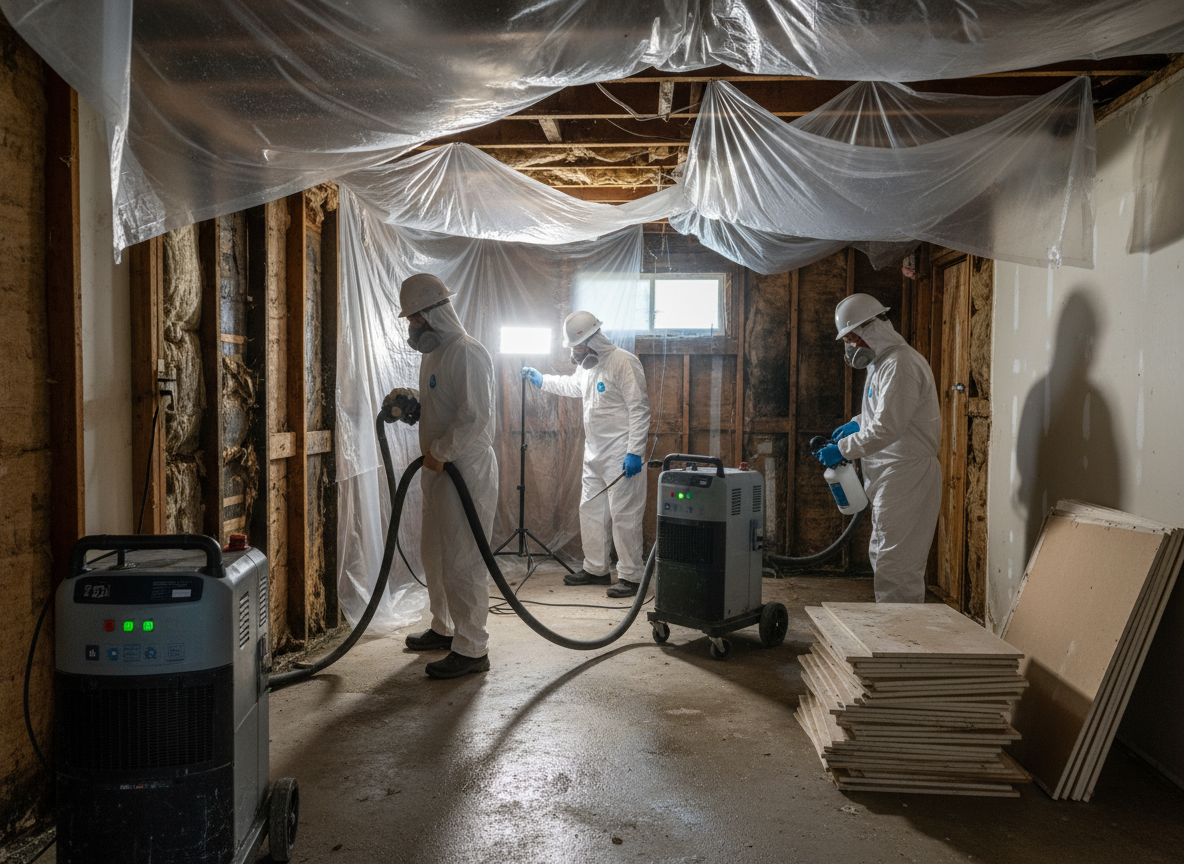
When a wall base or a cabinet has stayed damp for weeks, mold remediation is the service that follows. Growth in this climate can start in about a day or two on a damp surface, and a closed seasonal house can run for weeks before anyone notices the smell. Remediation is containment, removal of what cannot be saved and correction of the moisture source.
We also cover Three Oaks, Estero, Cypress Lake, Fort Myers Beach, McGregor and Gateway, all within about ten miles of San Carlos Park.
Why use us in San Carlos Park?
Because the water here is rarely a single visible puddle, and the job is to find where it actually went. We read the wall base, the garage slab, the cabinet toe kick and the door track before proposing removal, and we separate the repair we can make from the well, plumbing or roofing work that belongs to another trade. We work from 8710 Alico Rd in south Fort Myers, a short drive from San Carlos Park, and we put the readings and the scope in writing. No licence number, certification, founding year or review is published here, because this business has not supplied any to state.
Why San Carlos Park water damage gets worse quickly
A damp wall in San Carlos Park is a growth environment for most of the year. Air conditioning keeps the interior cool, which also means cool surfaces stay below the dew point whenever humidity rises, and a wall base that took storm water stays damp long after the surface feels dry. In this climate, growth can begin on a damp surface in about a day or two.
The rainy season makes it worse. From June through November, a soaked lot has nowhere to drain, the water table is high and the next storm arrives before the last one has dried. A door track that leaked once will leak again. A cabinet base that swelled in July is still holding moisture in September. The practical cost of waiting is material: pad, particleboard, baseboard and drywall that could have been dried are removed instead, and a one-room job becomes a three-room containment.
How a San Carlos Park job runs, step by step
- Call and history. Tell us where the water appeared, whether it came from rain, a fixture or the ground, and what was wet first.
- Read the assembly. We mark reading points at the wall base, slab, cabinet and door track, and scan concealed areas with thermal imaging.
- Contain and extract. The work area is contained where growth is likely, standing water is extracted and saturated material is assessed.
- Dry against readings. Air movers and dehumidifiers run at the marked points until the assembly reaches a dry standard.
- Verify and hand back. Final readings are compared with day one, and the record names any well, plumbing or roofing repair that belongs to another trade.
What's included in a San Carlos Park job
- A moisture survey of the wall base, slab, cabinets and door tracks
- Thermal imaging where the entry point is concealed
- Extraction of standing water and removal of saturated material
- Containment and HEPA filtration where growth is disturbed
- Drying equipment positioned against marked readings
- A written record of readings before and after
- A named hand-off for well, plumbing or roofing repair
What a San Carlos Park call sounds like
Most calls from San Carlos Park start the same way: a damp patch on a hallway wall, a musty smell in a spare bedroom, or a lanai floor that stays wet days after the rain has stopped. The house is usually older, on a generous lot, and the water has been there longer than the owner thinks. That pattern is a product of how the community was built.
San Carlos Park was platted in 1953 and grew over the following decades, so a single street can hold a 1960s ranch next to a 1980s house. The older homes are slab-on-grade with supply lines buried in the wall and a water heater in the garage or a closet, and the pipe that fails is often the one nobody can see. A stain on the ceiling below a bathroom usually means the pan, the valve or the drain, not the roof. On the lots near Mullock Creek and its tributaries, the ground can stay saturated for days after a storm, and water then arrives through the wall base rather than through a break.
Lanais and screen enclosures are the second common entry. The slab there sits below the living floor, the track holds water, and a screened wall lets rain in sideways during a squall. Because the enclosure is not conditioned, a wet floor there is easy to ignore until the smell reaches the house. We read the track, the wall base and the cabinet floors together, and we ask whether the home is on a well and septic, because that changes how a backup is handled.
San Carlos Park is unincorporated Lee County, and the San Carlos Park Fire District has served the community since 1976. Permits for rebuilding go to the county, and the fire district is the first call for anything that smells of smoke or gas rather than water.
What should you do next?
Call (239) 499-1170 and tell us which room is wet, how long it has been wet and whether the house is on a well or septic. If water is near the panel or an outlet, stay out of the room. We work from 8710 Alico Rd, a short drive north, and we will tell you what to do before we arrive.
Around San Carlos Park
We regularly work near:
- 📍Mullock Creek Preserve
- 📍San Carlos Park Community Park
- 📍U.S. 41 corridor
- 📍Alico Road
Mold Remediation in San Carlos Park — Local Notes
- •Unincorporated Lee County, so permits and drainage sit with the county.
- •Land drains west through Mullock Creek toward Estero Bay.
- •Some streets are on city water and others on private wells.
- •Fire protection comes from the San Carlos Park Fire Protection and Rescue Service District, formed in 1976.