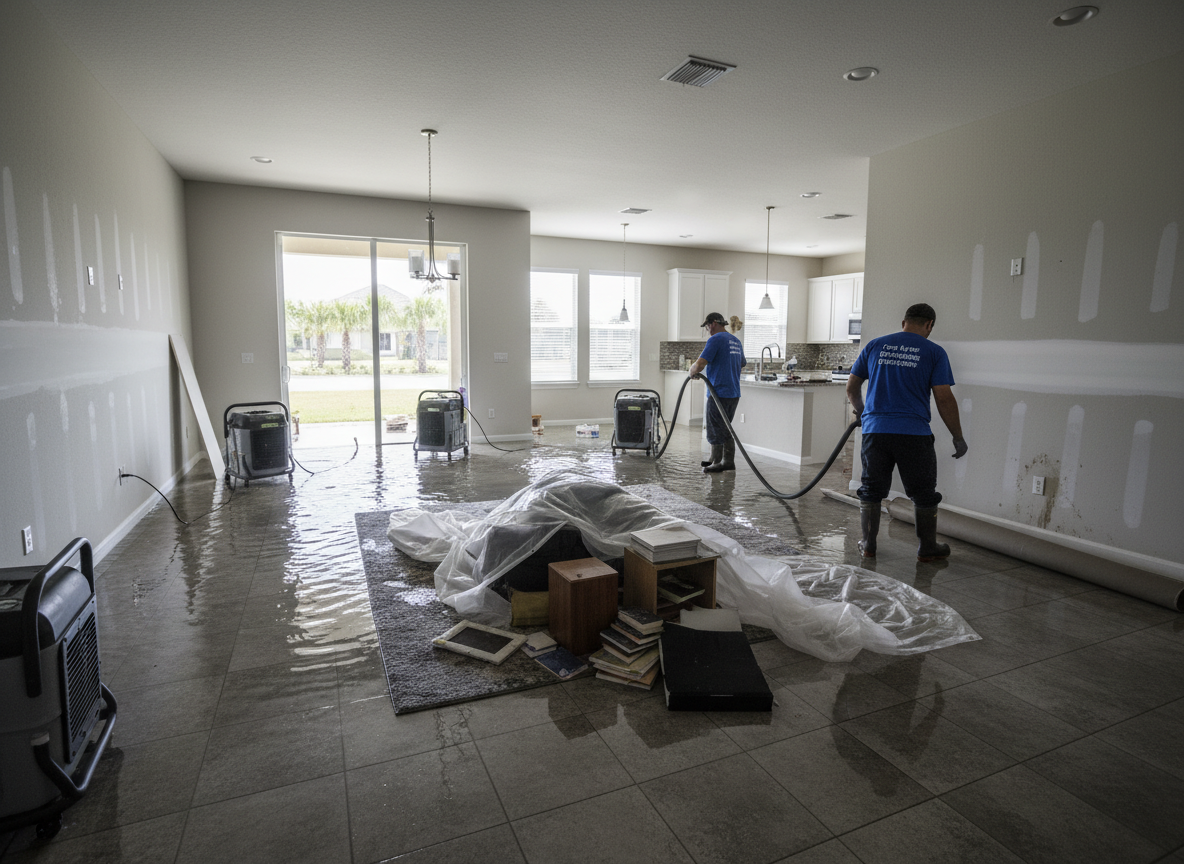
Cape Coral is a city of 194,016 people (2020 census) in Lee County, built on a grid of canals: more than 400 miles of navigable waterways run through it, and many of them connect to the Caloosahatchee River or Matlacha Pass. That geography decides how a water job starts. On a canal lot, water can arrive from the waterway, the irrigation line, the pool equipment or a supply pipe inside the wall, and the first task is to work out which one it was.
What makes water damage in Cape Coral different?
The canal is the difference. Most Cape Coral houses sit on a lot that drains toward water rather than away from it, and the same canal that carries storm runoff can push brackish water back into a lanai, a garage or a wall base. Add a high water table and sandy fill, and a small leak spreads sideways fast.
A city of canals in Lee County
Incorporated in 1970 on land first marketed in 1957, Cape Coral is one of the largest cities in Florida by land area, about 120 square miles, and its street grid is cut by more than 400 miles of navigable canals. The canals are not decoration: they are the storm system. Much of the city sits at or near sea level, so rain that cannot drain runs to the nearest canal, and when the Caloosahatchee is high or a storm pushes water inland, the canals rise with it. Hurricane Ian came ashore in Lee County in September 2022 and showed how far canal water can travel into ground-floor rooms. A canal-front address is a flood exposure as well as a view.
The housing that came with each phase of the cape
Cape Coral was sold as lot-and-home packages from the late 1950s, and the housing stock records each wave: early concrete-block ranches, 1970s and 1980s stucco homes with tile roofs, and the larger 1990s and 2000s houses with lanais and pool cages. Each wave brings its own failure points. Houses built from the late 1970s to the mid-1990s can have polybutylene supply lines, which fail at fittings rather than along the pipe. Older lanais often have a door track and a slab a step below the living floor, so water collects there first. Newer homes tend to fail at the ice maker line, the water heater pan or the air handler drain.
Sandy fill, a high water table and flat ground
The ground under most of Cape Coral is sandy fill over limestone, and the water table sits close to the surface. Water moves through sand quickly and sideways, so a leak under a slab or at an irrigation stub can show up as a damp wall base several feet away. Because the city is flat, there is very little fall for drainage; swales and canals do the work, and a blocked swale or a high canal means rain has nowhere to go. After heavy summer rain, the practical question is often not whether water got in but how long it stayed. Salt and silt left by canal water also change what can be saved.
Who serves Cape Coral
Cape Coral is its own city, so building permits, inspections and drainage questions go to the City of Cape Coral rather than Lee County. Utilities vary by neighborhood. South of Pine Island Road, most homes are on city water and sewer; the Utilities Extension Project has been converting older septic-and-well areas to city service, working north across the city. That matters on a water call: a septic system, a private well and a city sewer line fail in different ways, and a backup in a home on septic is handled as contaminated water from the start. We ask which system the house is on before any equipment is set.
What does a Cape Coral home need?
A Cape Coral water job usually turns on the source: canal, irrigation, pool, plumbing or rain. Once that is known, the work is either extraction and drying, storm and leak repair, or mold remediation, and each has a different scope.
When water has come in from the canal, a storm or a door track, water damage restoration covers extraction, leak detection and storm damage work. On a canal lot the entry point is often the seawall cap, the lanai track or the wall base rather than the roof, and brackish water changes what can be saved. We read the entry point before we open the wall.
When water is standing in a garage, a lanai or a carpeted room, water removal is the direct job. Carpet pad, cabinet bases and the bottom plate hold water in these homes, and tile set on a slab hides it underneath. Extraction and drying are judged on readings at those materials, not on how the floor feels.
When a wall or a cabinet has stayed damp long enough to smell, mold remediation follows. Canal water and a septic backup both leave material that should be treated as contaminated, so containment matters: we contain the area, remove what cannot be saved and correct the moisture source before anything is rebuilt.
We also cover McGregor, Cypress Lake, Fort Myers Beach, San Carlos Park and Three Oaks, all within about ten miles of Cape Coral.
Why use us in Cape Coral?
Because a canal-front house needs the water source read before the wall is opened, and because irrigation, pool and plumbing failures look alike from the inside. We mark readings at the wall base, the door track, the cabinet floor and the air handler pan, and we separate the drying work from the plumbing, roofing, pool and seawall work that belongs to another trade. We work from 8710 Alico Rd in south Fort Myers and we put the readings and the scope in writing. We do not publish credentials or reviews this business has not supplied.
Why Cape Coral water damage gets worse quickly
A damp wall in Cape Coral is a growth environment for most of the year. The city sits between the river and the gulf, humidity stays high, and air conditioning keeps interior surfaces cool enough to condense moisture whenever it rises. A wall base that took canal water can feel dry at the surface while the block behind it is still wet, and growth can begin in about a day or two.
The storm season adds a second problem. From June through November, the canals are high, the ground is saturated and the next system arrives before the last one has drained. A lanai track that leaked once will leak again, and a cabinet base that took brackish water in July is still holding salt in September. Waiting usually means removing drywall, cabinets and baseboards that could have been dried if the water had been read sooner. In a house on septic, waiting also turns a wet floor into a contaminated one.
How a Cape Coral job runs, step by step
- Call and locate the source. Tell us where the water appeared, whether the canal was high and what has already been repaired or replaced.
- Read the assembly. We mark reading points at the wall base, lanai track, cabinet floors and air handler pan, and scan concealed areas with thermal imaging.
- Contain and extract. The work area is contained where growth or contamination is likely, standing water is extracted and material that took canal or septic water is assessed.
- Dry against readings. Air movers and dehumidifiers run at the marked points until the assembly reaches a dry standard, not until the surface feels dry.
- Verify and hand back. Final readings are compared with day one, and the record names any plumbing, pool, roofing or seawall repair that belongs elsewhere.
What's included in a Cape Coral job
- A moisture survey of wall bases, lanai tracks, cabinet floors and the air handler pan
- Thermal imaging where the entry point is concealed
- Extraction of standing water and removal of material that cannot be saved
- Containment and HEPA filtration where growth or contamination is disturbed
- Drying equipment positioned against marked readings
- A written record of readings before and after
- A named hand-off for plumbing, pool, roofing or seawall repair
What about nearby areas?
Cape Coral shares the river with McGregor and Fort Myers Beach and shares its northern edge with Pine Island Road, so the same storm usually reaches all three. If your property is in McGregor, Cypress Lake or Fort Myers Beach, the source and the assembly are likely to be similar, and the call is the same.
What should you do next?
Call (239) 499-1170 and tell us where the water is, when it appeared and whether the canal was high at the time. If the floor is wet but the source is unclear, shut off the irrigation and the supply at the meter, keep people off wet tile and do not run the air handler over a wet pan. We will tell you what to do before we arrive.
Around Cape Coral
We regularly work near:
- 📍Cape Coral canal network
- 📍Cape Coral Bridge
- 📍Four Mile Cove Ecological Preserve
Mold Remediation in Cape Coral — Local Notes
- •Incorporated city in Lee County, so permits go to the City of Cape Coral.
- •More than 400 miles of navigable canals; many connect to the Caloosahatchee River or Matlacha Pass.
- •Founded 1957, incorporated 1970; population 194,016 at the 2020 census.
- •South of Pine Island Road most homes are on city water and sewer; the Utilities Extension Project is converting older areas further north.